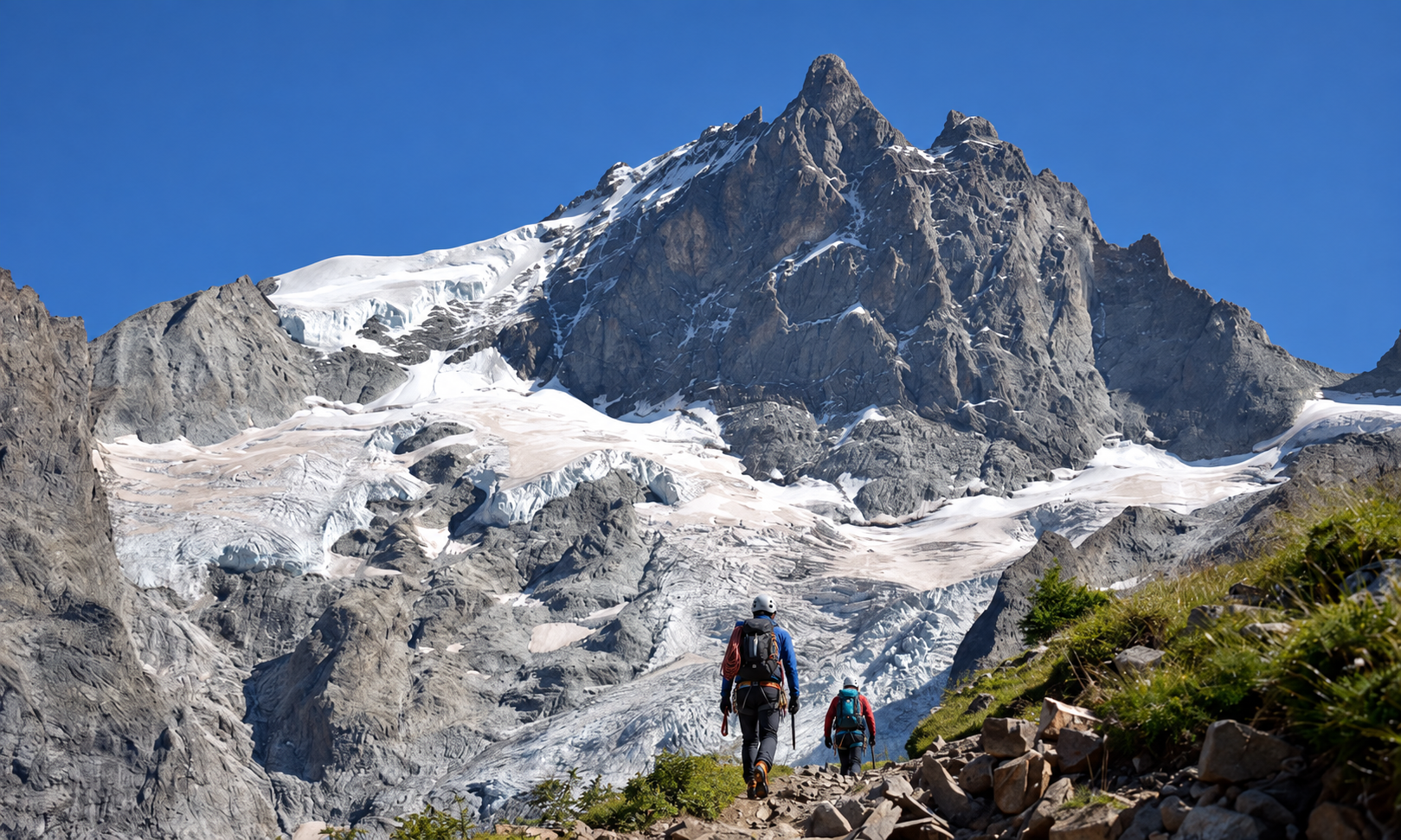
With Ju on the north face of Pic Sans Nom: thin ice, mixed climbing, doubts and shared joy on a Prestige–Russemberger link-up lasting into the night.
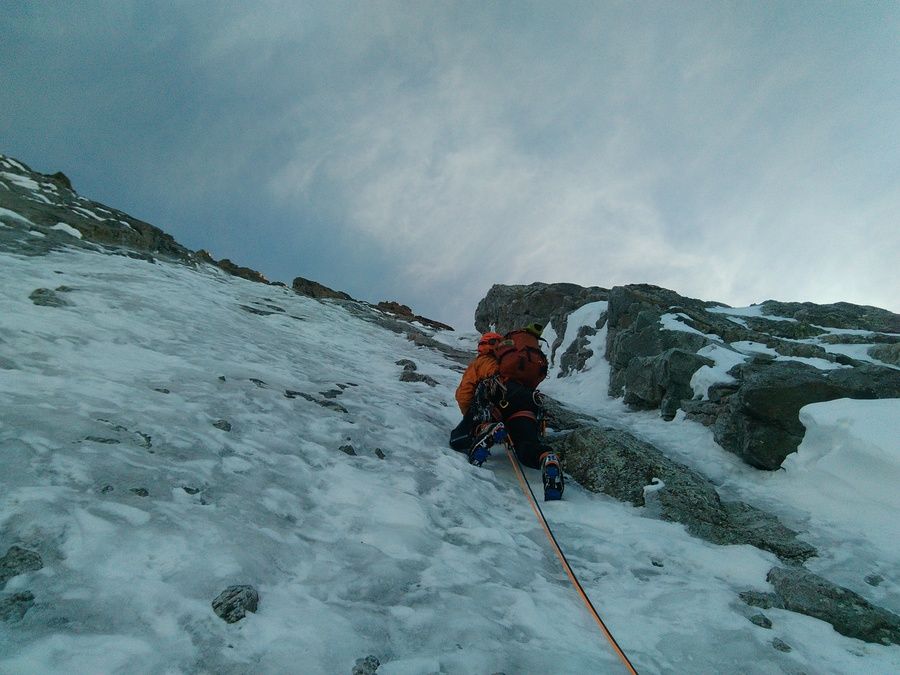
A nice little climb on the north face of Pic sans Nom with Mr. Loste himself to go “re-climb” the most talked-about route of the moment!! In the end, we’re not quite sure what to call this combination: the Prestige Russemberger Kavarec? The Georges des Ecrins?
First, let's take a step back to put into perspective some of the controversies that were fueled (for a short time) by a few keyboard warriors on the forum...
This is the Milky Way, our galaxy among billions of galaxies, and the yellow circle indicates our solar system.

Within this solar system, an ellipsoidal planet composed primarily of iron and oxygen provided the conditions necessary for primitive life forms to emerge more than 4 billion years ago, likely in the form of protein-coding molecules similar to DNA...
... a few billion years later, following a slow process of evolution, the Earth and life have indeed evolved. Entire continents have shifted, mountain ranges have risen and then been eroded, the Earth’s magnetic poles have reversed many times, and our protein soup has evolved into many significantly more complex forms.
Among these forms is the human.

Some humans—who will eventually turn to dust and are called mountaineers—enjoy climbing the mountains they name, which will eventually turn to sand and minerals at the bottom of the oceans.
In short, on a particle of the universe, life forms that, at first glance, had no chance of existing are climbing future piles of sand along ephemeral lines...
To avoid being swept up in this great metaphysical whirlwind, humans try to make sense of it all by describing and categorizing the world. It’s the same task the Shadocks undertook in their time. Organizing, naming, describing, explaining, classifying. But humans don’t all agree on how to go about it. Even the mountains are not immune to this madness.
Between October 19 and 21, 2015, three mountaineers—physically robust, well-versed in survival techniques at the M6+ level, masters of the art of improvised bivouacking and the “sun dance,” and unafraid of spindrift, ice screw sets, or freeze-dried food, managed to overcome the challenges of a fleeting line of solidified water on a peak called Sans Nom. And they are likely the first to have ever passed through there. Their joy is immense.
Upon their return after a refreshing shower, they rush to share their news with their peers. Using a subtle binary code, they transmit their message to convey information in the form of words and images. Converted into electrical impulses or waves and received by other people’s retinas, the message is decoded; after being processed by their cerebral cortex, it produces roughly the same reaction in most of their peers: “Way to go, guys!”
Yet some people seem to question the originality of this journey, citing a few "flimsy" arguments in support of their claim.

What if we just decided we didn't give a damn? That typing on a keyboard is just as pointless as climbing a mountain—except for the person doing it... that we can give all of this whatever meaning we want, and that, in the end, none of it matters at all?
So yes, it’s true—some modern mountaineers enjoy thrilling others because it allows them to focus their lives even more on the mountains, to acquire the gear needed to climb other rocky peaks, where they’ll push themselves to the limit, experience hunger and thirst, experience beautiful stories of friendship with snot running down their noses, and nourish their souls and egos. Aside from the gear considerations, I gladly count myself among this group.
May the Ecrins Mountains always retain their charm and seclusion!
---------------------------------------
Anyway, for us at least, our eyes were definitely treated to a spectacular sight when we saw that beautiful route. I didn't think I'd have the chance to climb it this year. I wasn't really in shape, I didn't have a climbing partner available, and I had a thousand little projects to finish...
After following in the footsteps of my friends, the Écrins Prestige guides, the mountain bug has taken hold in my little “north face junkie” brain, and the idea of going there for a visit just won’t leave me alone!
Ju just got back from Sri Lanka... After a month living in the tropics, he’s totally relaxed!! I hit him up with this plan, and of course he’s all for it right away! With our dad schedules, we can’t go for another 5 days... Perfect! That way we can get ready... Well, we haven’t done any hard climbing in months—we’ll skip that; it’s too late now... We decide on two climbing hikes to get some elevation gain and warm up on 5s... We need to work on our stamina and calf muscles!!
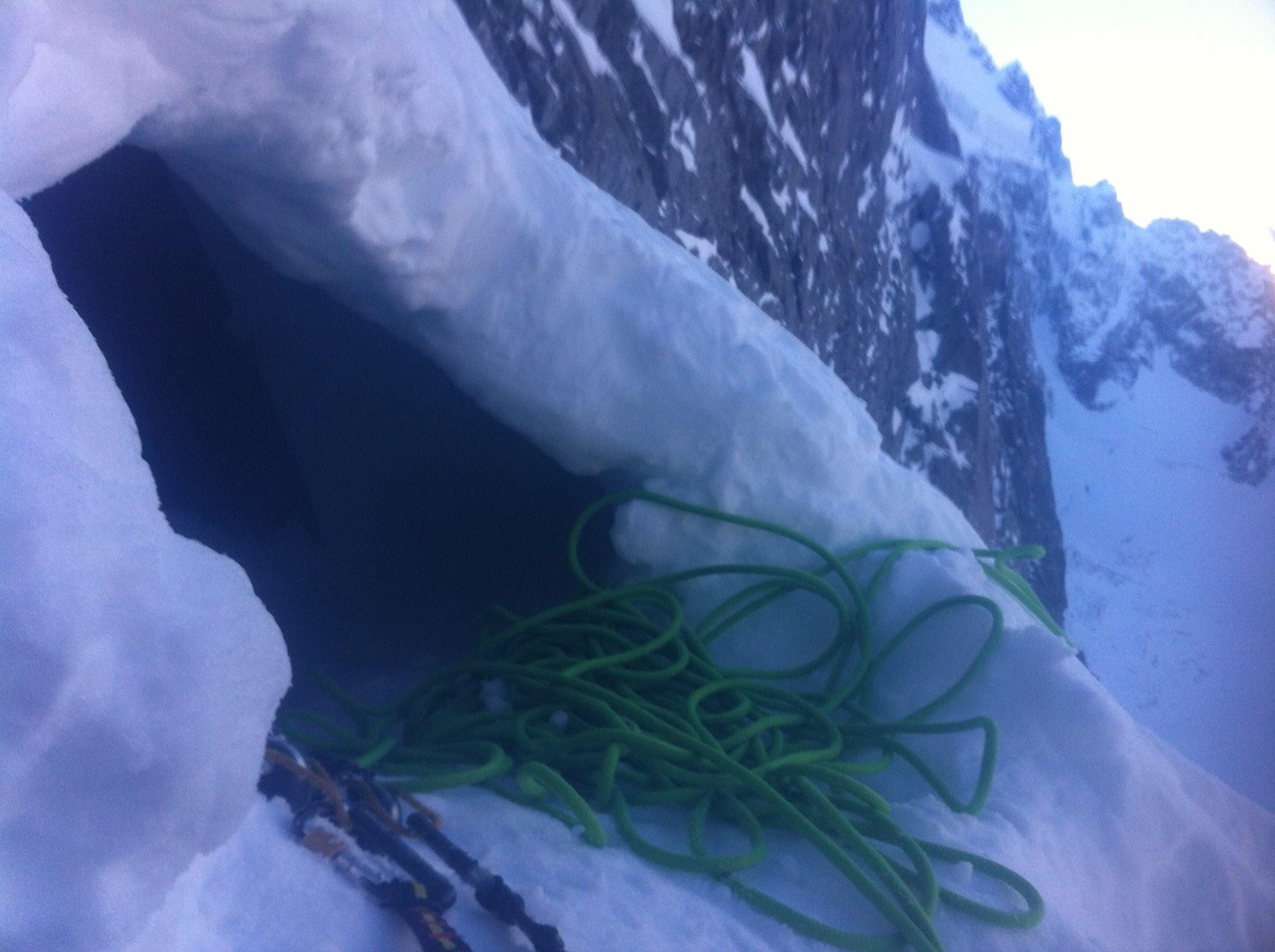
We're taking advantage of these days to gather info from our friends (Ecrins Prestige) and the guides (thanks, Tough)... The sight of the "cueva" dug out by Tough and Antoine really motivates us!!
Tuesday, November 10—here we go. We set off at 3:15 a.m. from Pré de Madame Carle with our bags loaded with scrap metal, textiles, goose feathers, and drinkable and edible supplies. Based on the information we have, camping seems unavoidable...
Things have been going pretty smoothly in the area lately. The trail to the base of Pic Sans Nom is excellent. We had to zigzag a bit on the flat section at the base of the face, but on the crevassed slopes, it’s good again.
At 6:30 a.m., we're at the bergschrund, where we find Grandpa Brochard's walking stick.

I start the traverse that leads to the beginning of the difficult section. Jonathan and Antoine’s tracks, as well as those of the Spaniards and Italians, are visible. A little trouble with the rope to kick off the day. No stress—we’ll make it!
We set out from L2 (a good ledge with a strap left behind by the Italians who made it out after their first bivouac). It’s still dark. We take our time. We get organized and take care of everything we can.
7:25 a.m., here we go. I tackle the pitch. At the base of this nearly vertical wall, I pretend to be relaxed, but questions are racing through my little brain in every direction: “Do I really belong here at the base of this vertical pile of rocks and ice?” The start is hesitant. I climb a meter, then slide back down. Twice. Ju encourages me, and I can tell he’s doubting himself, too. Then, little by little, the rhythm kicks in, the questions fade away—a handhold here, an ice axe there… The hardest part was getting started!
The conditions are excellent all the way down! Pure, crisp snow and good protection that’s not too hard to find. Everything you need for a real treat!
8:05 a.m.: belay change! We haul the heavy pack up with the second rope—that’s our “strategy”! That way, the lead climber can tackle the difficult pitches without the pack. Since we didn’t bring a hauling sling, the pack is a true climbing partner—except that it can’t remove the protection or unclip itself! So, in addition to climbing, the second climber is in charge of dealing with the pack’s antics… though it’s been pretty cooperative today!
8:20 a.m.: We're both at the belay station, energized by that first beautiful 30-meter pitch and the very promising conditions!
Ju moves on to the next section, making a clever start to reach a partially iced dihedral. Ju sets off and makes good progress. Good protection—we’re not worried.
9:20 a.m.: The two of us are at the belay station 60 meters higher up (a station set up by the Italians during their retreat; there’s also one halfway up), feeling confident about what lies ahead!
A bit of mixed terrain up ahead, and we reach the first snowfield, where the "pioneers" set up camp.

I keep chipping away at the ice. The north wind has dried out the face a bit—less cleaning to do, but the ice layers are getting thinner!! I quickly decide not to set too many ice screws anymore, since they hit the rock after only a few centimeters of travel... My brain goes blank. As usual, just when I need them, the pitons are at the bottom of my pack or 60 meters below, on my buddy’s harness!!
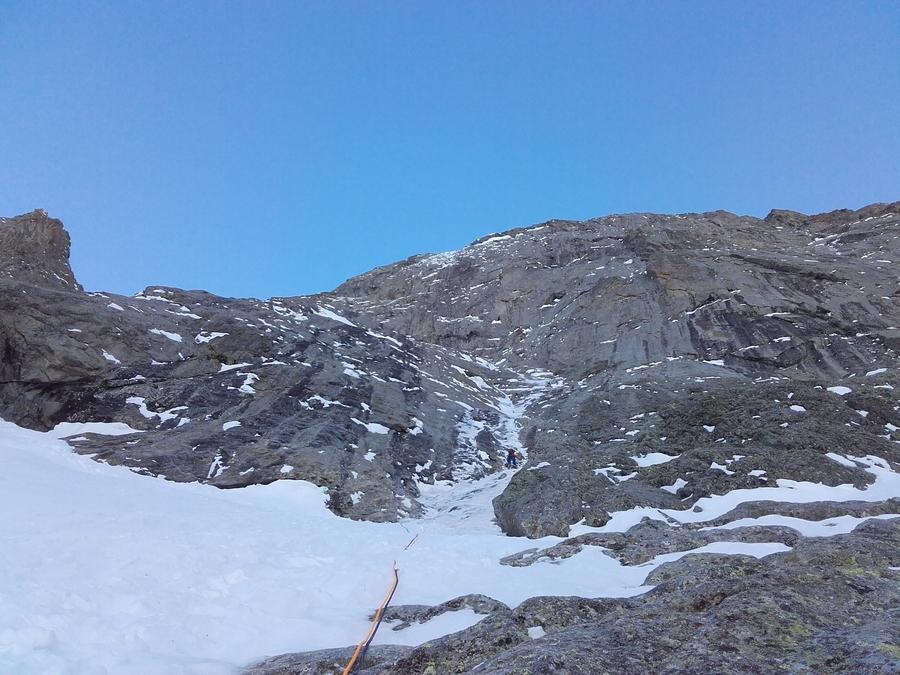
The excellent conditions let you let loose and climb with confidence. Once past the first hold, I anchor as best I can, place two Tiblocs, and we move on with the rope taut.
Ju takes over 100 meters higher up to start the turn that leads us to the campsite. More exposed sections and still insane conditions!
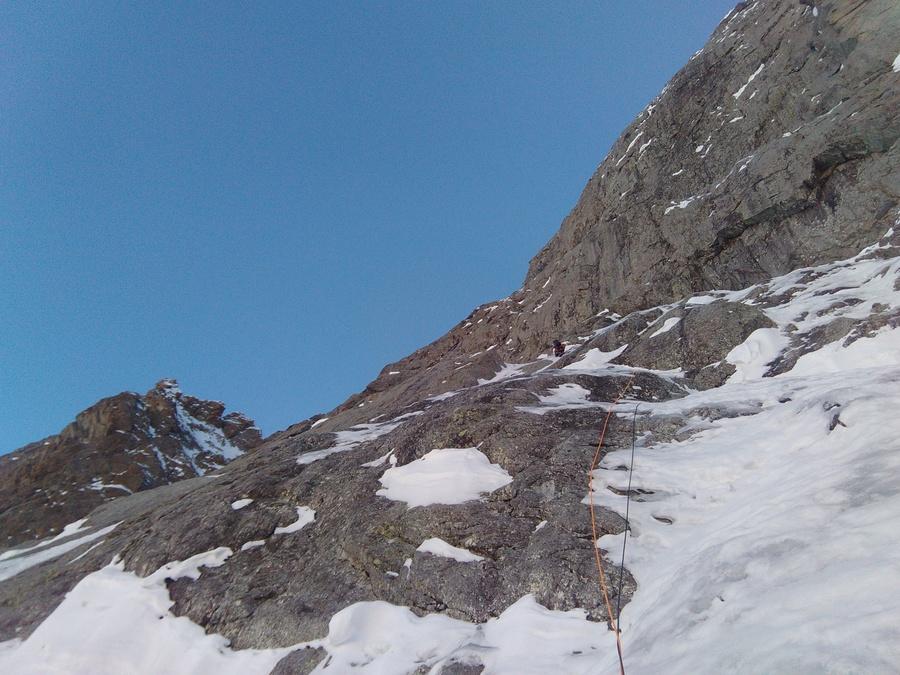
12:00 p.m.: We’re at the campsite known as “La Cueva.” This is where we planned to sleep!! There are still 6 hours of daylight left; the effects of not being in shape are starting to set in, but our desire to keep going is just too strong!! We take three-quarters of an hour to eat and replenish our water supplies, which are now empty since we’d planned to bring just enough to get us this far...
12:45 p.m.: Ju sets off again on the M5+ or 5c pitch of the Russemberger route. After some hesitation, Ju opts for some good old-fashioned climbing—without crampons or an ice axe—passes a piton, and sets up a belay on a snow ledge.
We leave the route-setters’ dry-tooling variant behind us and continue up the Russemberger to the left. It’s a chance to stick your butt out (and clench it tight) on this psycho little slab with your feet on tiny icy bumps, protected by the tiniest of our Camalots! Otherwise, it’s a 4c in climbing shoes!
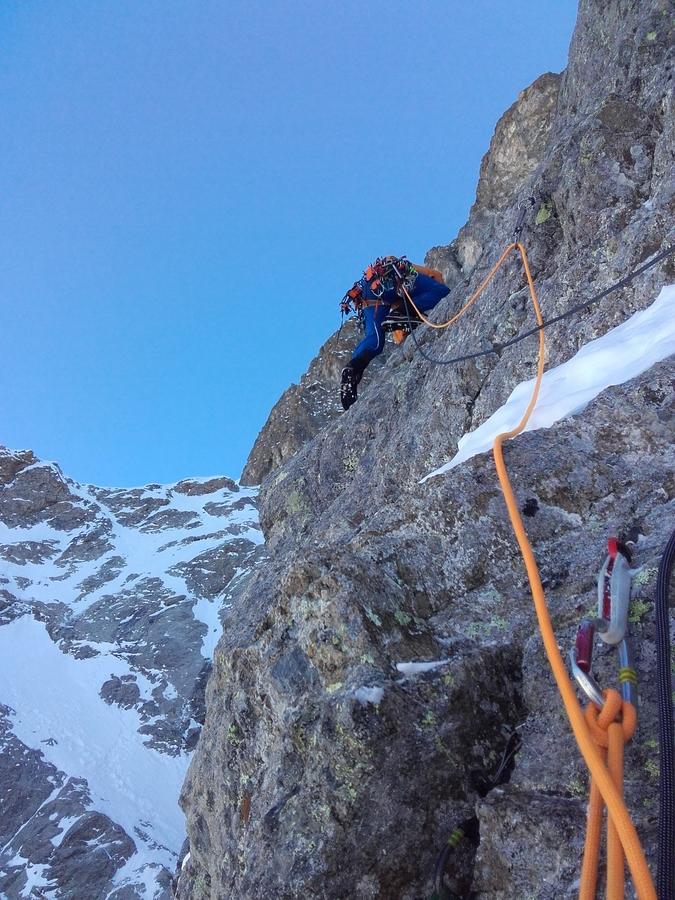
It's a rock corridor that's much more fun to climb now than it is in the summer, I suppose!
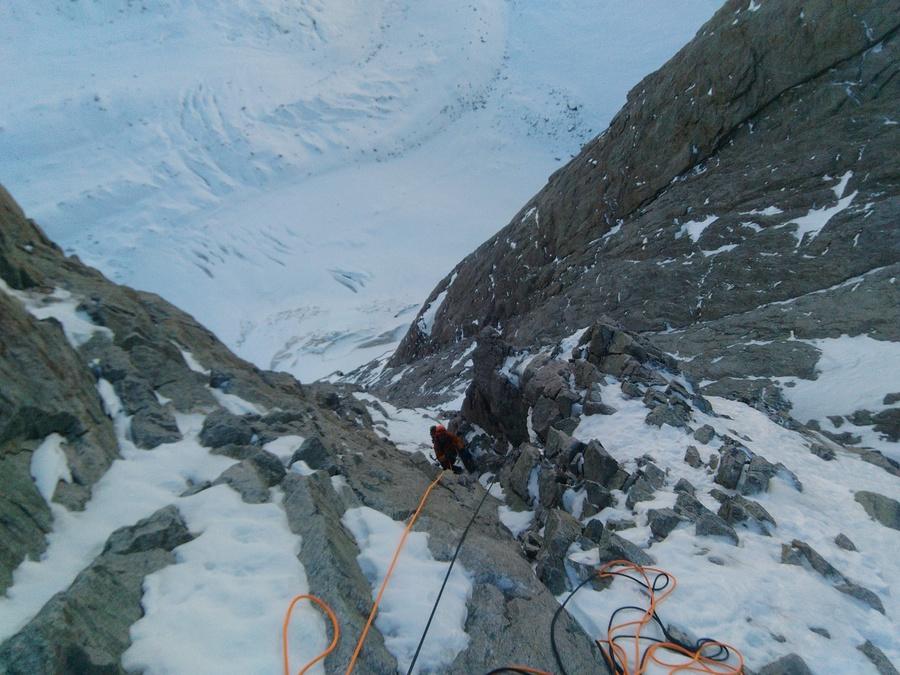
I’m taking my turn at the start of the long “Gueux” traverse. Actually, it’s not just a traverse—it also goes downhill at times. The atmosphere is getting more and more intense, and the protection gets worse and worse toward the end of the traverse… An excellent ledge makes it easy to take my turn with confidence.
3:25 p.m.: It's crazy how quickly time flies on these north faces! I'm heading back up a steep section of slabs, part of which is almost vertical and covered in crinkly snow.
All of this takes place above the large overhang where the line of bolts we’re climbing ends. It’s not exactly unnerving. I hardly ever try to place bolts anymore. There’s excellent protection in the rock, but it’s often spaced 10 meters apart or more... An 80-meter pitch allows me to set up a belay on three solid pitons at the base of a beautiful gully. Ju takes over.

A 60-meter pitch and more slabs await us. I’m leading again. Nothing too extreme, but it’s still hard to place protection properly. When climbing feels like solo climbing! Mom, don’t worry—the photos are all doctored!!

I place bolts whenever I can—two small bolts—and then we hurry along, rope taut, through a system of gullies and then ascending ramps to the left to get as high as possible before nightfall.
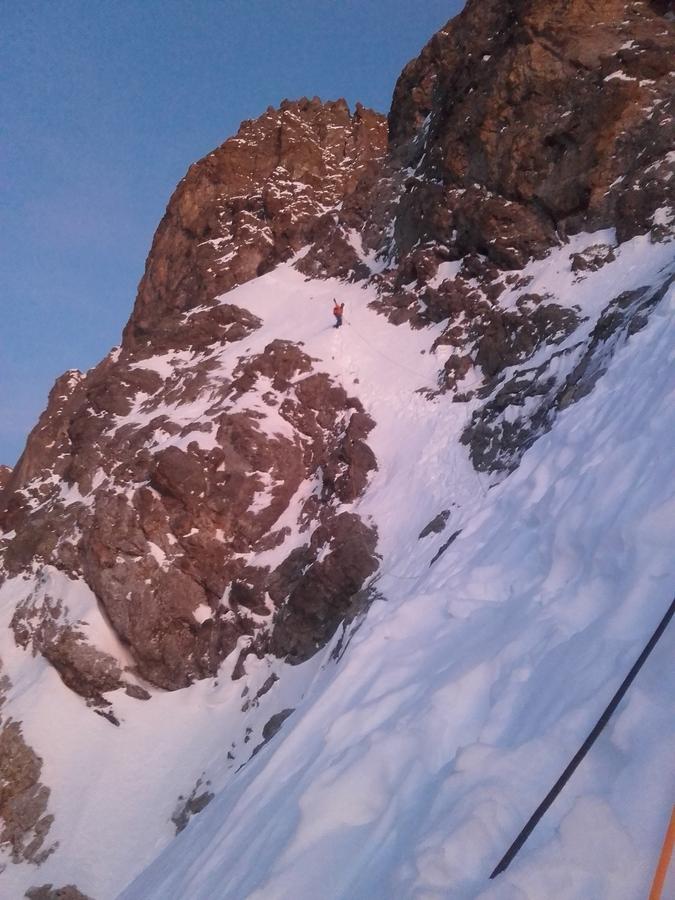
It’s 6 p.m. when we collapse at the base of the summit gully. Night is falling—it’s time for a break! If we’d known better, we would have packed much lighter, and by now we might already be strutting around at the summit!
We take an hour… to take a break… to switch off our brains, step away from the world of veneers for a bit, get away from it all… We devour the 500 grams of pasta. Not freeze-dried at all. Pretty heavy, but really good!! Then we eat whatever comes our way—cookies, dried fruit, tea… I should mention we’ve got two days’ worth of food with us and even a little extra, so we can really go all out. We restock our water supplies for the final stretch. We’re exhausted but super motivated by the idea of camping at the Pelvoux refuge. I sing Ju a love song in Spanish. Ju loves Spanish, but I’m not sure he appreciates my singing voice quite as much!!
7:00 p.m.: Marcel’s back in the saddle. We climb two long pitches by night up the fossil ice gully that descends from the breach. Finally, the ice screws are coming in handy!!
8:30 p.m.: We did it! After that endless final gully, we hugged each other at the summit! So much joy! On the other side, we could see the lights of the valley—life down below reminding us it’s still there. A quick call to our friends—they’re surprised but relieved! Thanks, girls, for letting us go play in the mountains!!
The strong wind (50 km/h) at the top of the trail is urging us to head downhill. We have no doubt now—we’ll be spending the night in Pelvoux!
3–4 rappels, snowfields, then we descend by feel at night through an overhanging gorge via 3 rappels and a bit of downclimbing. Fatigue is really starting to set in, and everything becomes a struggle: walking, coiling the rope, freeing gear that gets stuck, knots that form, the backpack digging into us, pebbles rolling under our feet... ouch, ouch, ouch...
Midnight: Staggering, we push open the door to the Refuge du Pelvoux, completely wiped out! We know the biggest mistake we could make would be to go straight to bed without eating or drinking anything. So we hang around in front of the stove. We wolf down whatever we can before falling into a deep, blissful sleep until the next day!
-----------------------------------------------------------
A few technical details for future participants: given excellent conditions like the ones we had, the one-day route is a must!
It took us 14 hours from the bergschrund to the exit, given that:
- that we took a half-hour break at the foot of L2
- that we spent three-quarters of an hour fetching water at the Cueva campsite
- that we spent an hour eating and filling our water bottles at the base of the summit gully
- We ended up lugging around about 3 kilos each of useless gear, which really weighed down our bags.
A well-coordinated climbing team that isn't carrying too much gear and is in good shape should be able to reach the breach in 10 hours.
As for gear: we were carrying way too much!! We set out with two complete sets of Camalots from 000 to 1, plus sizes 2 and 3. 10 pitons. 4 bolts. 5 slings. One ball nut. We consistently finished each pitch with a lot of gear hanging from our harnesses. We didn’t use any pitons. And we rarely placed more than 5 pitons per pitch given the thickness of the rock (except for the final gully, where we placed all 10 pitons—but with the rope taut, it’s possible to split it into several pitches and place protection in the rock).
Under these circumstances, we believe the following equipment is sufficient:
- a complete set of Camalots up to size 2, with two of each of the small yellow, blue, and purple ones
- 8-pin
- 2 blade pitons
- a ball nut (not essential, but since we had one, we used it)
Client Testimonials (0)
No testimonials yet. Did you join this outing? Leave your review!
Write a review
Share your experience of this adventure. Access restricted to participants.
Want to experience this type of adventure?
Contact me to plan your custom high-mountain project.
Contact me