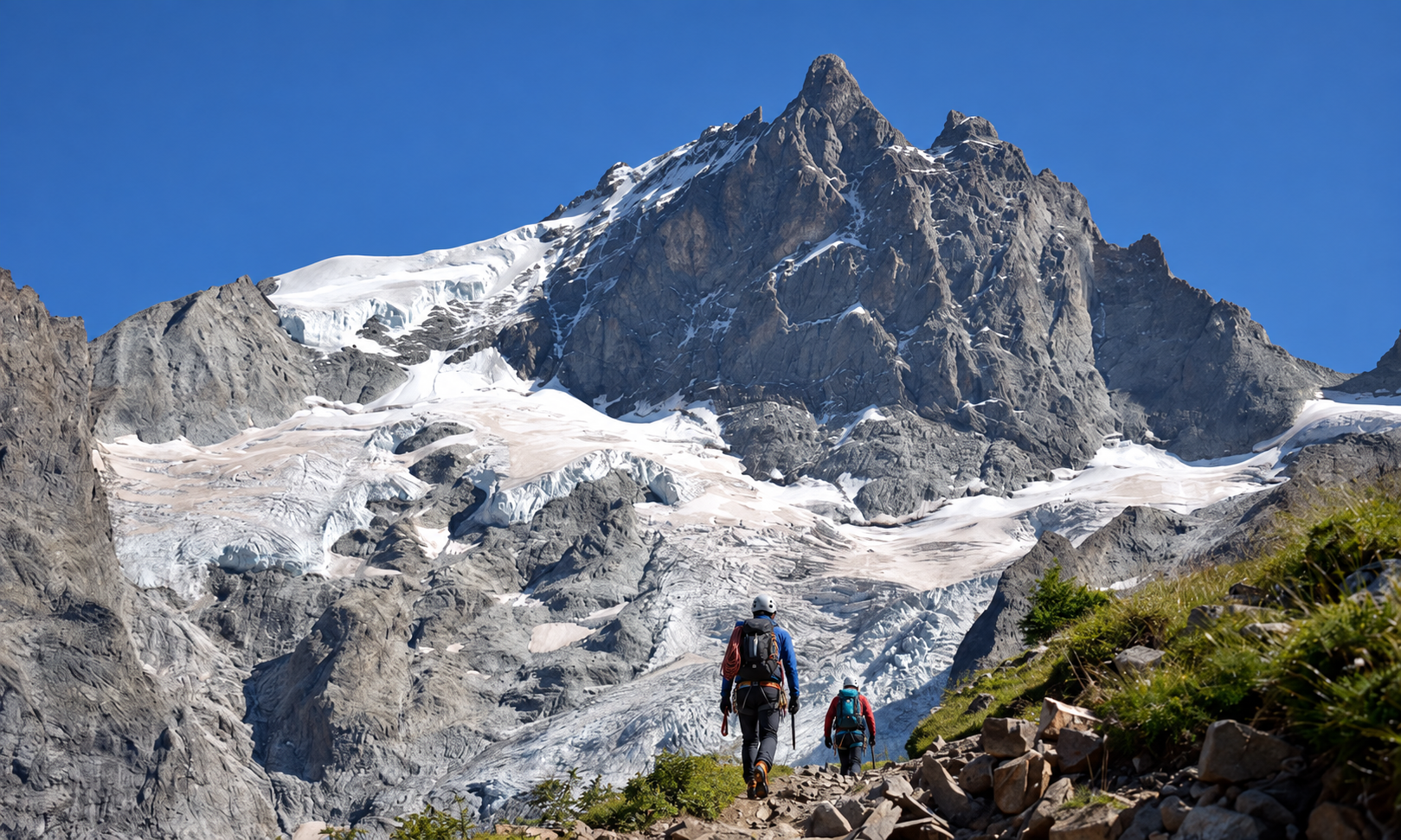
Seb and I went to Switzerland to ski and ended up climbing the Eiger’s north face via the Heckmair Route. From a bivvy in the grass to a well-earned beer.
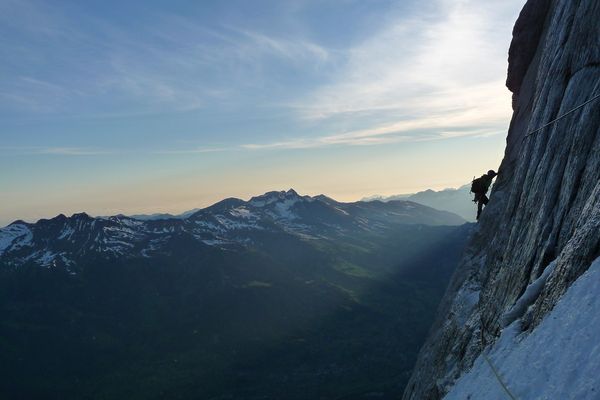
Ah, the north face of the Eiger! A cornerstone of Alpine lore, with a history that hasn’t always been pretty. One of the three great problems of the Alps, it was finally climbed in July 1938 by Heckmair, Vörg, Kasparek and Harrer after an epic ascent. An astonishing feat for its time. If you love north faces and their history, the Heckmair Route is quite something.
I’d originally come to Switzerland to ski with Seb. But we had to admit we’d landed a perfect window for the Eiger. The face still had plenty of snow and the freezing level was low enough to give us a decent chance of keeping half the mountain from landing on our heads. We expected company, but all we saw was one mysterious rope team two hours behind us. They seemed to come out of nowhere, possibly from the Stollenloch, a tunnel that opens onto the face some 500 metres above its foot, below the Rote Fluh. Sorry, we didn’t name the places.
We took the train up to Kleine Scheidegg among tour groups from India, Korea and elsewhere. The last train carried everyone back down and the station went quiet again. We found a four-star bivvy in the meadows just nearby.
Alarm at 1 a.m. Again! It’s starting to hurt a little less. At 3 a.m. we got going on the first 450 metres of rock steps and snowfields. That turned out to be the trickiest section for route-finding. The climbing was straightforward and opportunities for protection were scarce, so we climbed unroped. At dawn, a pitch brought us to the Difficult Crack. To our right, the 250-metre overhang of the Rote Fluh made our heads spin. Around 500 metres below, the first rays of sunlight were already reaching the pastures. We took it all in. Once through the crack, we moved together to the start of the Hinterstoisser Traverse.
This was the traverse that sealed the fate of Kurz, Hinterstoisser, Rainer and Angerer in 1936. Hinterstoisser had got across with some clever ropework and a fair bit of nerve. Once all four were across, they pulled the rope. Forced to turn back after an injury, they couldn’t reverse the traverse and tried to descend directly. None survived. Exhausted, Toni Kurz died hanging from his rope just metres from the rescuers who had come out through the Stollenloch. Grim.
When we climbed it, the traverse had fixed ropes, as did several other sections. In rock shoes the climbing wouldn’t be particularly hard. Even so, you have to admire the nerve and the streak of madness it took to be the first to see what lay on the other side.
We crossed a series of snowfields and climbed a 100-metre ice runnel with around 20 metres at 80°. It had been ages since I’d climbed ice! At the top of the Second Icefield, a short mixed section to the right of the Flatiron (yes, really) brought us to the Death Bivouac. This was where Karl Mehringer and Max Sedlmayr were last seen during their attempt in 1935. The face steepens sharply here, and the route takes a lovely natural line up the Ramp.
Hard snow and ice gave us good conditions. We climbed the Ramp in three pitches. The third is the crux, with a steep mixed start at M5 and two snow plugs to get past. In those conditions, it was a treat.
At the top of the Ramp we went 50 metres across the Brittle Ledges, which were snow-covered for us. We climbed the Rotten Crack (5b and rather cleaner with age), then followed the airy Traverse of the Gods to the White Spider, a snowfield with gullies radiating from it. It was ice for us, and our calves were burning. An easier runnel brought us to the Exit Cracks. This is where Heckmair fell onto Vörg on the first ascent before the team managed to stop the fall. The story goes that the pair then downed a bottle of amphetamines a doctor had slipped into their first-aid kit.
One more pitch of proper climbing and a short pendulum abseil brought us to the Corti Bivouac. In 1957, after eight bivouacs on the face, Claudio Corti was rescued here by means of a cable lowered from the summit. His partner Stefano Longhi, who had fallen lower down, couldn’t be saved. Corti had been struck by a rock, and the two Germans he’d continued with left him there while they went for help. They were found four years later on the west flank.
Above the bivouac (this one wasn’t four-star), we moved together up a long gully of black rock. Another 200 metres of snowy ridge and there was the summit of the Eiger, waiting for us. We hugged in the eerie mist, delighted to have lived out this climber’s dream together. We took our time up there, quite happy in our own little world.
There was still enough snow on the west flank to get us down in an hour and a half. We ended up back at Kleine Scheidegg with tankards of beer and an excellent meal. Life is good!
Practical Info / Route Topo
J1 — Train and bivvy at Kleine Scheidegg
- We leave the skis behind, take the train up and wait for the last one to head back down before settling into our bivvy in the grass.
J2 — The north face via the Heckmair Route
- We start at 3 a.m. and reach the Hinterstoisser Traverse at dawn, then climb the Ramp, the Traverse of the Gods and the White Spider. We reach the summit in the mist and descend the west flank for a beer at Kleine Scheidegg.
Client Testimonials (0)
No testimonials yet. Did you join this outing? Leave your review!
Write a review
Share your experience of this adventure. Access restricted to participants.
Want to experience this type of adventure?
Contact me to plan your custom high-mountain project.
Contact me